Why 74% of Consumers Only Trust Reviews From the Last 3 Months
BrightLocal's 2026 survey found 74% of consumers only value reviews from the past 3 months. Here's what that means for your business and how to build a review system that keeps your reputation fresh.
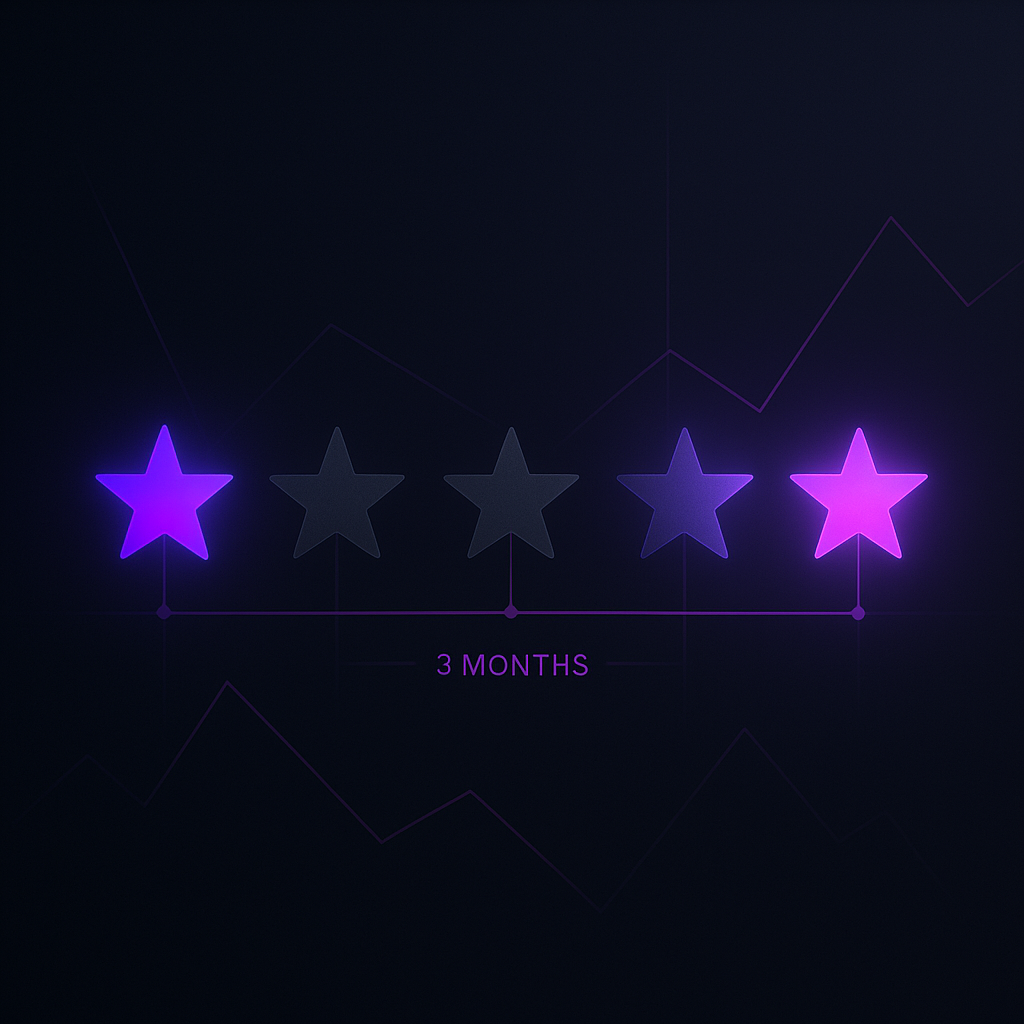
You worked hard for those reviews. Forty-seven five-star ratings, accumulated over three years. You're proud of them. You should be. But here's the uncomfortable truth: according to BrightLocal's 2026 Local Consumer Review Survey, 74% of consumers now only trust reviews from the past 3 months. Those 5-star reviews from 2024? Most of your potential customers are ignoring them entirely.
This isn't a minor shift in consumer behavior. It fundamentally changes the review strategy for every local business. If you're not generating new reviews every single week, your online reputation is decaying in real time — even if your star rating looks great on the surface.
The good news: this also means you don't need hundreds of reviews to compete. You need a consistent, recent stream. Here's what the data says, why review freshness matters, and how to build a system that keeps your reputation current.
The 74% Stat: What BrightLocal Found
BrightLocal's 2026 Local Consumer Review Survey — the most widely cited benchmark in the local SEO industry — revealed several findings that should reshape how businesses think about reviews. The headline number: 74% of consumers only value reviews written within the past 3 months. That's up significantly from prior years, reflecting a growing consumer awareness that businesses aren't static.
The survey also found that 31% of consumers now require a 4.5-star rating or higher to consider a business, and 45% of consumers used AI tools for local business discovery in 2026 — up from just 6% in 2025. These numbers paint a picture of a consumer who is more discerning, more AI-aided, and more focused on recency than ever before.
The implication for local businesses: your review strategy can't be 'get a bunch of reviews and coast.' It has to be 'generate reviews continuously, forever.' The businesses that internalize this will pull ahead. The ones that don't will watch their hard-earned reputation silently expire.
Why Recency Matters More Than Volume
There's a logical reason consumers have shifted toward recency: businesses change. Quality can decline after a management change. Staff turnover can affect service. A restaurant that was outstanding in 2024 might have a different chef in 2026. Consumers have learned this the hard way — enough disappointing experiences at 'highly-rated' businesses have taught them to check the dates on reviews.
AI agents are reinforcing this trend. When ChatGPT or Gemini evaluates review signals for a business recommendation, they weight recency more heavily than volume. The AI is trying to recommend a business that will deliver a good experience today, not one that was great two years ago. It interprets a steady stream of recent reviews as a signal of ongoing quality; a large backlog with no recent reviews reads as a business that may have declined.
This flips the traditional review strategy on its head. Previously, the advice was 'get as many reviews as possible.' Total count was the north star metric. Today, velocity — the rate at which you're generating new reviews — matters more than the total number. A business with 20 reviews from the last 3 months will outperform a business with 200 reviews from 2 years ago, all else equal.
What Happens When Your Reviews Go Stale
The consequences of stale reviews extend beyond lost trust with individual consumers. Google's local ranking algorithm factors review recency into your position in the local pack. Businesses with fresh reviews consistently outrank those with stale ones, even when the stale-review business has a higher total count.
AI Overviews compound this. When Google's AI generates a summary answer for a local query, it prioritizes businesses with active, recent review profiles. A business with no reviews in the past 90 days is less likely to appear in an AI Overview than a competitor with steady recent review activity — regardless of total review count.
There's also a psychological effect. When a potential customer sees your most recent review is from 8 months ago, they don't think 'this business must be consistently good.' They think 'nobody has reviewed this place in 8 months. Why? Did it close? Did it decline?' An empty recent review feed raises questions you don't want customers asking.
- Stale reviews hurt local pack rankings — Google's algorithm weights recency
- AI Overviews deprioritize businesses without recent review activity
- Customers interpret a lack of recent reviews as a negative signal, not a neutral one
- Competitors with active review generation will overtake you regardless of your total count
Building a Review Cadence System
The fix isn't complicated, but it requires consistency. You need a system that asks every happy customer for a review, every time — not a one-time push, not a 'review month' promotion, but an ongoing, automated workflow that makes review requests a natural part of your customer interaction.
The target cadence: 3 to 5 new reviews per week, minimum. This keeps your review profile consistently fresh in the 90-day window. At this pace, you'll maintain roughly 40-65 recent reviews at any given time — enough to satisfy the 74% who only trust recent reviews and the 31% who require 4.5+ stars.
The mechanics: send a review request within 24 hours of service completion, while the experience is still fresh in the customer's mind. Use SMS — it has a 98% open rate compared to roughly 20% for email. Include a direct link to your Google review form. Make it effortless. If the customer doesn't respond to the first request, send one follow-up 3 days later. Then stop — don't nag.
- Target 3-5 new reviews per week to maintain a fresh 90-day window
- Send review requests within 24 hours of service via SMS (98% open rate)
- Include a direct link to your Google review form — remove all friction
- One follow-up after 3 days, then stop — two requests is the sweet spot
How Reviews Feed AI Search Visibility
The review recency trend takes on additional importance in the context of AI search. As covered in our articles on GEO and how AI agents choose businesses, review signals are one of the primary data sources AI engines use when deciding which businesses to recommend.
When a customer asks ChatGPT 'who's the best-rated HVAC company near me,' the AI isn't just checking your star rating. It's evaluating your review velocity, recency, and diversity across platforms. A business generating 4 new reviews per week across Google, Yelp, and Facebook sends a much stronger AI trust signal than a business with 200 reviews from 2023 on Google alone.
This is the multiplier effect of review recency: fresh reviews don't just build trust with human customers. They build trust with the AI agents that increasingly mediate between customers and businesses. Every new review is both a trust signal for humans AND a data point for AI recommendation engines.
Want help implementing this?
Get my free snapshot tailored to your business.
Frequently Asked Questions
How do I get 3-5 new reviews every week?+
Automate the ask. Set up an SMS-based review request that triggers after every completed job or transaction. If you serve 20 customers a week and ask every one, a 15-20% response rate gets you 3-4 reviews. The key is consistency — ask every customer, every time, within 24 hours of service. Tools like Braxus's reputation management system can automate this entire workflow.
What if I get a negative review? Doesn't asking for more reviews increase the risk?+
Statistically, happy customers are less likely to leave unsolicited reviews than unhappy ones. An automated system that asks EVERY customer — not just the ones you think are happy — actually improves your average rating because it captures the silent satisfied majority. And if a negative review does come in, responding within 48 hours with a professional, solution-oriented reply can turn it into a trust signal.
Do review platforms other than Google matter for recency?+
Yes. Google is the most important platform, but consumers and AI agents also check Yelp, Facebook, and industry-specific sites. Your review recency matters across all platforms. Prioritize Google first, then Yelp for service businesses and restaurants, then Facebook and industry-specific directories.