The 2026 Local Search Stack: SEO + GEO + AEO + VEO Explained
Traditional SEO isn't enough anymore. Learn how SEO, GEO, AEO, and VEO work together as a connected stack to make your business visible everywhere customers search.
Five years ago, local SEO meant one thing: rank in the Google 3-pack. Optimize your GBP, get some reviews, build a few citations, and you were visible. That was the whole game.
Today, your customers are searching for businesses in four completely different ways. They're typing into Google. They're asking ChatGPT for recommendations. They're using voice assistants in their kitchens and cars. They're scrolling YouTube and TikTok for video reviews and walkthroughs. If you're only optimized for one of these surfaces, you're invisible on the other three.
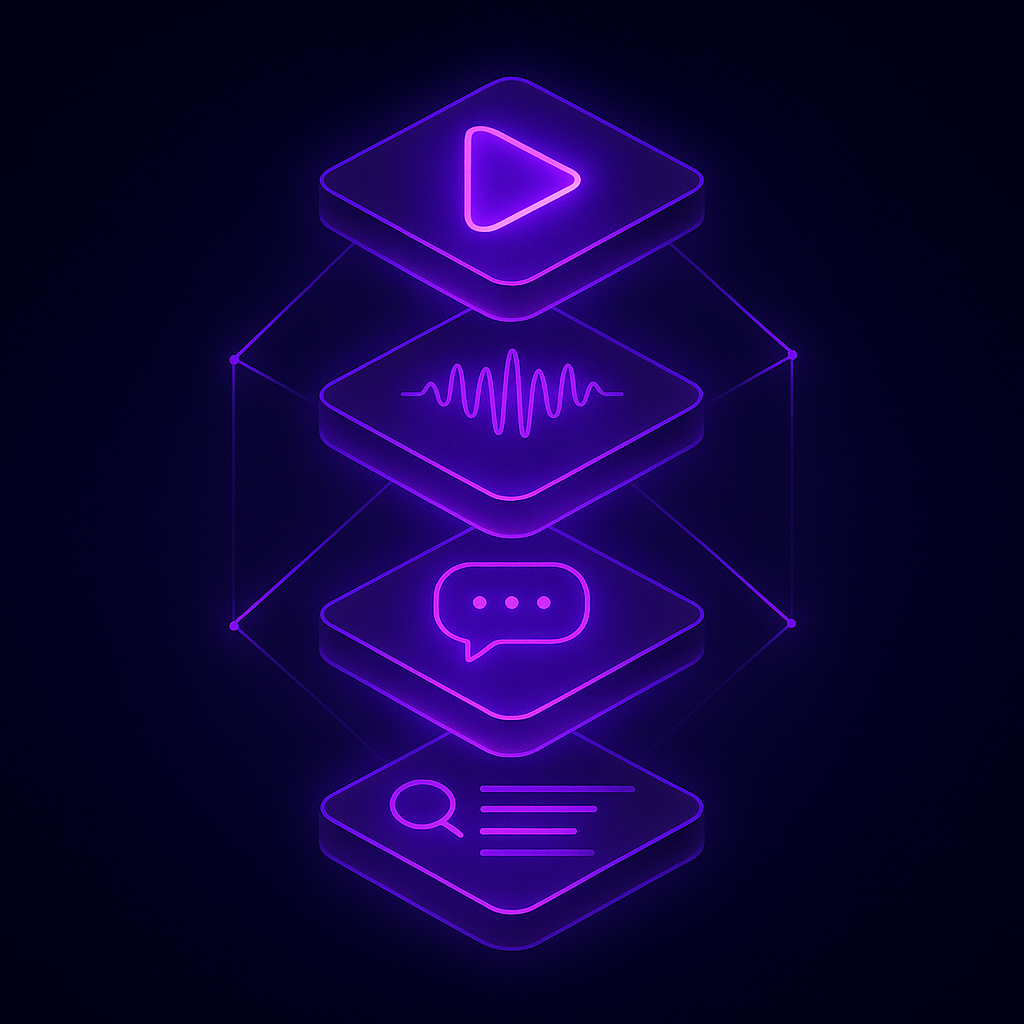
The businesses winning in 2026 aren't doing four separate things. They're building a connected stack — SEO, GEO, AEO, and VEO — where each layer reinforces the others. This article explains what each layer does, how they work together, and the checklist to make sure your business is covered on all four.
Layer 1: SEO — The Foundation
Traditional search engine optimization is still the base layer. It covers your visibility in Google Search results — the 10 blue links, the local 3-pack, Google Maps, and image search. When someone types 'plumber near me' or 'best Italian restaurant Atlanta,' SEO determines whether your business shows up.
For local businesses, SEO in 2026 centers on a few non-negotiable fundamentals. Your Google Business Profile must be complete, verified, and active — with accurate categories, current hours, recent photos, and weekly posts. Your website needs location-specific pages with proper on-page optimization. Your NAP — name, address, phone — must be consistent across every directory and citation source. And you need a steady stream of recent reviews, because Google's algorithm weights review recency more heavily than ever.
SEO hasn't become less important. It's become table stakes. If you're not visible in traditional search, the other three layers of the stack have nothing to build on. But SEO alone isn't enough anymore — because your customers aren't searching the way they used to.
- Complete and active Google Business Profile with weekly posts and fresh photos
- Location-specific website pages with proper on-page optimization
- NAP consistency across all directories and citation sources
- Steady review velocity — recency matters more than total count
Layer 2: GEO — Getting Cited by AI Chatbots
Generative Engine Optimization is the newest and fastest-growing layer. It covers your visibility in AI chatbots like ChatGPT, Google Gemini, Perplexity, and Claude. When someone asks these tools for a business recommendation, GEO determines whether your business gets named.
GEO works differently than SEO. Traditional SEO is about ranking against competitors for keywords. GEO is about being the business the AI cites by name — and AI agents typically cite only 1 to 3 businesses per query. The AI is building its recommendation from your Google Business Profile, your reviews, your citations, your website's structured data, and third-party mentions from independent sources. Every inconsistency across these sources erodes the AI's confidence in your business.
The practical GEO playbook: keep your GBP complete and active, generate reviews consistently, audit your citations for exact NAP matches, add LocalBusiness and FAQ schema to your website, and pursue third-party mentions through chambers of commerce, local news, and industry directories.
Layer 3: AEO — Being the Answer That Gets Spoken Aloud
Answer Engine Optimization covers your visibility in voice search and answer boxes. When someone asks Siri, Alexa, or Google Assistant a question, AEO determines whether your business is the answer that gets spoken aloud. It also covers featured snippets and 'People Also Ask' boxes in Google search results.
AEO requires a different content strategy than traditional SEO. Voice assistants and answer engines extract clear, concise answers from well-structured content. They look for questions presented as headings, followed immediately by direct answers of 40 to 60 words. FAQ schema markup helps these engines parse your content programmatically.
A critical AEO step most businesses miss: claiming your Apple Business Connect listing. Siri pulls local business data from Apple Maps and Apple Business Connect — not from Google. If you're not on Apple's platform, you're invisible to roughly 55% of US smartphone users for voice search.
- Claim and complete your Apple Business Connect listing — essential for Siri visibility
- Structure FAQ content with questions as headings and 40-60 word direct answers
- Add FAQ schema markup so answer engines can parse your content programmatically
- Actively manage your GBP Q&A section — it feeds Google Assistant directly
Layer 4: VEO — Video Engine Optimization
Video Engine Optimization is the most overlooked layer of the stack — and the fastest-growing. It covers your visibility in YouTube search, Google video results, TikTok, Instagram Reels, and any platform where customers discover businesses through video content.
YouTube is the world's second-largest search engine, and Google increasingly surfaces video results in standard search queries — especially for 'how-to' and 'before and after' searches. A business with a YouTube channel featuring walkthroughs, customer testimonials, and service demonstrations has a visibility asset that compounds over time. Video content also feeds into AI training data and can influence GEO citations.
VEO for local businesses doesn't require a production studio. Short-form video — 60 to 90 seconds — optimized with keyword-rich titles, descriptions, and tags, published consistently, is the play. Each video should target a specific customer question or showcase a specific service. Over time, these videos build a searchable library that works across YouTube, Google, and social platforms.
How the Four Layers Work Together
The power of the stack isn't in any single layer. It's in how they reinforce each other. A complete Google Business Profile feeds SEO, GEO, and AEO simultaneously. A new customer review improves your local pack ranking, increases your chances of AI citation, and provides fresh content for voice assistants. A well-structured FAQ page with schema markup boosts your traditional SEO, gets you into featured snippets, and makes you citable by AI agents.
This is why the stack is more than the sum of its parts. Businesses that optimize each layer independently — doing SEO here, GEO there, AEO somewhere else — will always be slower and less effective than businesses that build a connected system where every action benefits multiple layers.
- A complete GBP feeds SEO, GEO, and AEO simultaneously
- Fresh reviews improve rankings, AI citations, and voice search visibility at once
- FAQ schema boosts traditional SEO, featured snippets, AND AI citability
- Video content builds VEO while providing training data for AI agents (GEO)
The Stack Checklist: Is Your Business Covered?
Here's a practical audit to see where your business stands across all four layers.
- SEO: Is your GBP complete and posting weekly? Are your citations clean? Is your website optimized for local keywords with dedicated location and service pages?
- GEO: Does your website have LocalBusiness and FAQ schema? Are you generating 3-5 new reviews per week? Do you have third-party mentions from chambers, directories, or local news?
- AEO: Have you claimed your Apple Business Connect listing? Do your service pages have 40-60 word answers to common customer questions? Is your GBP Q&A section active and monitored?
- VEO: Do you have a YouTube channel with at least 10 videos optimized for local search? Are you publishing short-form video content consistently? Do your video titles include local keywords?
Want help implementing this?
Get my free snapshot tailored to your business.
Frequently Asked Questions
Do I really need all four layers?+
The layers you prioritize depend on where your customers are searching. Every business needs SEO — that's table stakes. If your customers use voice assistants, add AEO. If you want to be cited by AI chatbots, add GEO. If you serve customers who watch video reviews or how-to content, add VEO. Start with SEO, audit where your customers actually search, and build the layers that match.
Which layer gives the fastest results?+
SEO can show movement in 30-90 days if your fundamentals are in place. GEO takes longer — 60-120 days — because AI models need time to absorb changes to your online presence. AEO shows results quickly if you're fixing a specific gap like an unclaimed Apple Business Connect listing. VEO is a long game — it builds over 6-12 months as your video library grows.
How does VEO actually work for local businesses?+
Create videos that answer your customers' most common questions — 'how to unclog a drain,' 'what to look for in a roof inspection,' 'tour of our dental office.' Optimize each video title and description with local keywords. Publish on YouTube and embed on your website. Over time, these videos rank in both YouTube and Google search results, and they provide rich content that AI agents can reference when making recommendations.